|
Mississippi River - Buddhist Pilgrimage/Walking on Faith and
Kindness - March 2005 - Page #1
--- --- ---
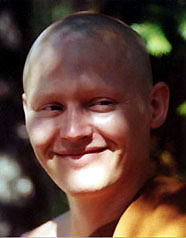
Jotipalo
Bhikkhu, a Buddhist monk from the Abhayagiri Buddhist
Monastery, in Redwood Valley, California and Austin
Stewart from
Gunnison, Colorado completed an 1,800-mile walking pilgrimage
from New Orleans, Louisiana to Thunder Bay, Ontario, Canada.
The plan was to dedicate any merit
from the pilgrimage to peace, both individual peace for all
beings and for world peace.
 You
can read/free download the complete journals in PDF -- Mississippi
Journals PDF You
can read/free download the complete journals in PDF -- Mississippi
Journals PDF
Jotipalo Bhikkhu
|
|
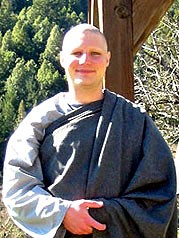 Austin
Stewart
Austin
Stewart |
|
------------
Wabash College - Buddhist monk begins 1,800-mile Mississippi
pilgrimage
- by Steve Charles - March 2, 2005 -
The
last time Tan Jotipalo ’88 undertook such a long
journey was in the foothills of the Himalayas, where he
had a near-death experience that led to his eventually
becoming a Buddhist monk.
On
March 1, the former Wabash art major was hoping for a
little less drama but no less illumination as he began
a six-month, 1,800-mile walking pilgrimage along the Mississippi
River from New Orleans to Thunder Bay, Ontario.
Jotipalo
and Buddhist layman Austin Stewart of Gunnison, Colorado
will survive completely on donations in the Buddhist tradition
of wandering known as Tu Dong. Theirs is the first walk
of this kind in the United States.
"By
giving people the opportunity to participate in the walk
(by offering food or shelter), we hope to open up people’s
hearts—to be be a catalyst to inspire other people
to do good."" Jotipalo told the Thunder Bay
Chronicle-Journal.
"Our
walk is also a physical demonstration of renunciation,
and a return to simpler values," Jotipalo said. "For
me, this is training in giving up comfort. It’s
learning to improvise and deal with hardships—thunderstorms,
tornados, not knowing where you’re going to stay
that night. . . . Learning how to deal with those kinds
of emotions."
Wabash
College - P.O.Box 352, Crawfordsville, IN 47933
------------
|
1.
An impossible task?
2.
American Tudong/An Experiment in Wandering
3. Pushing the Envelope
4. The Devil's Seed in Our Midst—We
Can't Trust Stereotypes
5. Snowy Egrets and Cranes Grace
the Sky
6. Have Patience with It
7. The "Old Farts," and
Chanting Against Fear and Despair
8.
Sharpened senses/loving kindness
to coyotes
9.
Rocky Springs, Mississippi
10.
The Natchez Trace
11.
Not the Impossible Task I Envisioned
12.
"Yellow next to red, leaves a fellow dead"
13.
Poison ivy
14.
Jotipalo earns his merit badge
15.
Walking feet, running nose
16.
A blessing for Eddie Johnson
17. A first Word from Austin/A
little miscommunication
18.
A like-minded soul
19.
Chanting on the battlefield
20.
Generosity in Mind
21.
Thai generosity/talking with Father William
22.
"What the bleep do we know?"
23.
Levitating in Yazoo, or: first Jesus, now the Buddha
------------
1.
An impossible task? Day 1: New Orleans, Louisiana - Jotipalo
Bhikkhu - March 1, 2005
It's
1 p.m., Tuesday, March 1, and I'm on a pier above the Mississippi
River.
Taking
the train from Chicago to New Orleans made me feel like we have
an impossible task ahead of us. It seems like an eternally long
way. A little bit of doubt has crept in, and last night I came
down with a sore throat and a low-grade fever. Just something
mild.
On
the train, I was reading John Steinbeck's Travels with Charley.
He mentions a similar apprehension at the beginning of his journey:
"In
long range planning for a trip, I think there is a private conviction
that it won't happen. As the day approached, my warm bed and
comfortable house grew increasingly desirable and my dear wife
incalculably precious. To give these up for three months of
the terrors of the uncomfortable and unknown seemed crazy. I
didn't want to go. Something had to happen to forbid my going,
but it didn't. I could get sick, of course…"
We've
been staying with Chris and Billy Finney, two of Austin's friends
he's known since high school, and Austin admitted feeling a
little apprehensive and nervous about the trip. I was feeling
like, "Oh, God, what are we getting into." And Chris
and Billy were saying, "We'd give anything to go—you
guys can't really be talking this way!" Everyone is excited
about the journey, but we're the ones doing it, and I think
it has occurred to us: "Just what are we getting into?"
This
morning we just decided to go for it; if I wait until my health
is great, I'll never get started. And today is an absolutely
beautiful day in New Orleans. Billy Finney said they get this
kind of weather maybe three weeks out of the the year—mid-60s,
completely sunny, a gentle breeze.
We've
decided to walk along the levee at first. We've walked three
miles so far, and we're going to try to walk about 9 miles a
day. We have no idea where we're going to stay tonight, but
we did see a couple of plantations up the way with some long,
beautiful lawns. We're going to stop and ask if we can sleep
on one of them. The owners will probably say no, but Billy said
the people have a reputation for kindness, so we'll just ask
and see if we can't spend our first night on a plantation!
Monday,
I had the best cup of coffee I've ever tasted. They put chickory
in the coffee, and it was so good. My first taste of New Orleans.
Then Billy drove us through the river delta where the Mississippi
empties into the sea, and down to Pilottown, where we stood
by a sign that said, "You are now on the southernmost point
in Louisiana."
On
Sunday we came here to Rivertown and a Greek man came over and
started talking with us. He said, "Ah, yes, I have a neighbor
who went to a Buddhist monastery in Germany, and it's been very
good for him. Buddhists—now they're the ones who ride
horseback blindfolded and shoot at targets, right?" He
has inspired us to start writing down all the stories we here
when someone says, "Ah, I know about Buddhism…"
As
we were standing on the same pier, four kids from the neighborhood,
ages six to ten, came up to us. They were great, and we talked
to each other for a long time. Then one of them looked at me
and said, "Why do you wear them ugly clothes?"
Billy
asked him, "Do you go to church?"
"Yeah."
"Does
your minister wear robes?"
"Yeah."
"Well,
that's what Jotipalo is doing."
"Oh,
yeah."
The
people we've been staying with have been wonderful. Billy's
brother, Chris, does musical mixing as a recording engineer,
and he was working last night with a famous saxophonist, a Grammy
winner.
On
the train down here I was walking back from the view car and
a man put his palms together in anjali (a greeting of respect).
I talked with him later and found out he is from the Missouri
Zen Center. We had lunch together, and I asked him if he knew
the monk Santikaro. He said he'd once driven with him all the
way to Missouri. We exchanged emails and he's going to try to
set up something for us when we show up in St. Louis. It's such
a small world.
Still,
I'm kind of worried about this first week. We'll be on the levee,
at least until Baton Rouge, and a couple of miles north of here
are a lot of chemical plants—they call it "Cancer
Alley." Finding places to sleep might be hard for us, and
everything's wet. As a monk, I'm allowed to ask someone if we
can sleep in their backyard under one of these trees. Or, if
they ask us in, we could spend the night indoors. But I hope
we spend most of the nights outside.
On
the train ride down I watched the scenery—extremely flat
and extremely poor. People in the South have told me that the
poor people will probably be more receptive to us. I could see
many places from the train where we could sleep when we come
back through—wooded lots and abandoned shacks.
We've
been walking now for just an hour and a half. We're excited
to be getting started, but also aware that this is a big task.
Much is unknown.
2.
American Tudong/An Experiment in Wandering - Austin Stewart
- March 8, 2005
The
Theory
My
house is a mess. Camping gear and paperwork comming from the
couch flow down onto the floor; my bed I would rather not talk
about. The only place that has survived the storm is the shrine;
it is neat, orderly and clean. This scene is a reflection of
the mind. It is racing and busy and alternately calm. I am preparing
to embark on a very long walk as the lay supporter of Venerable
Jotipalo Bhikkhu on a six-month journey that will take us north
along the Mississippi River from New Orleans to Thunder Bay,
Canada.
Ven.
Jotipalo is a monk in the Thai Forest Tradition of Theravada
Buddhism. The Thai Forest Tradition has distinguished itself
through its strict adherence to the Vinaya, a code of discipline
set forth by the Buddha and as the name of the lineage suggests,
there are strong ties to living in and learning from the forest.
We will conduct this walk in line with the Vinaya, living on
almsfood and keeping our needs to a minimum. We will eat one
meal a day, have access to medicine when ill, and will have
shelter from the elements. I will live by the Eight Precepts;
Ven. Jotipalo will live by the full code. I am along on this
walk to support his needs that may not be apparent to a largely
Christian population and to handle money if need be.
I
met Ven. Jotipalo several years ago when I began studying at
Abhayagiri Buddhist Monastery outside of Ukiah, California.
Two years ago Ven. Jotipalo started discussing the idea of doing
a long tudong, or walk, in the U.S. On my last visit this May
I offered to accompany him.
Several
questions have come up from friends and relatives, the two most
common being, "Why," and, "Why the Midwest and
South?" In answer to the second question Ven. Jotipalo
says that aside from being raised in the Midwest, his heart
told him this was a good place to do it. I remember when I first
considered offering to walk with him, my judgments about where
we would walk created the sounds of a lynch mob in the mind.
Having those judgments was a big part of my decision to walk
with him. I knew that I had to challenge that resistance in
the mind.
The
first question is much bigger. The question really being asked
is what is the purpose? What is the goal? We will undoubtedly
raise awareness of Buddhism in rural and urban America; we will
undoubtedly discuss the Dharma and our way of life with people.
But these are not the full reasons for the walk. Ven. Jotipalo
and I have only discussed a few of his reasons for going on
the walk. The study of the mind is the core of this walk, when
we cast ourselves into uncertainty how will the mind respond?
We also discussed dependency on others. Being dependent we give
people the opportunity to show kindness. Ven. Thanissaro Bhikkhu,
the abbot of Metta Forest Monastery in San Diego County succinctly
describes the benefit of giving for the giver,
“After all, when you give, you put yourself in a position
of wealth. The gift is proof that you have more than enough.
At the same time it gives you a sense of worth as a person.
You’re able to help other people. The act of giving also
creates a sense of spaciousness in the mind, because the world
we live in is created by our actions, and the act of giving
creates a spacious world: a world where generosity is an operating
principle, a world where people have more than enough, enough
to share. And it creates a good feeling in the mind.”
Ven.
Jotipalo originally wanted to label this as a peace walk, but
he has changed his mind, or more accurately he has changed his
semantics. Unfortunately, peace has become a very political
word. It is a divisive word; if you want to get people riled
up talk about peace. Flash people two fingers and there is a
good chance they will show you one. We have to find other means
to communicate with people.
I
am in a bar in Washington D.C. A large man in his late thirties
sits down next to my friend, grabs her cigarettes, puts one
in his mouth and then asks if he can borrow a lighter. Aversion
and outright disgust arise instantly in the mind. When he begins
to talk he compounds the situation; I find him to be the most
irritating being on the planet. But then metta (loving kindness)
arises in the mind and I let go of the aversion that I am feeling
for him, and really look at him. He and I are the same. We share
desire and aversion, greed and delusion and we also share that
which is not those things. I had spent all day at a protest
against the invasion of Afghanistan . He says that he is not
pro-war, but that he is anti-antiwar. This starts a discussion
that leads through the events of 9-11 to a point where we can
communicate. We could have argued about peace and war and protest
for hours without ever really communicating, but we are both
human beings, if I can let go of my views and opinions and keep
metta in mind we can begin to talk. That’s what happened,
we got to a very basic place where we talked about fears and
spirituality and the mind, and we left the discussion respecting
each other. My friend still runs into him sometimes in D.C.
and he always asks about me.
The
example that we set on this walk must be an example of peace.
American over-consumption is responsible for so much strife
in the world. In a land that glorifies excess, we choose to
make our footprint as small as possible. We cross a nation at
war having undertaken the precept to harm no living being. We
embrace discomfort among people who endlessly seek comfort.
Buddhism
is a wilderness tradition. If you look to the Buddha and major
teachers from the Sixth Zen Patriarch to Milarepa, to the great
Thai teacher Ajahn Mun Bhuridatto, they all spent years wandering
through the forest, sitting in caves and on mountaintops. Buddhism
in this country lacks that. It is confined to cities and sitting
groups, and the occasional monastery and retreat center. The
Buddha trained in the forest, realized enlightenment in the
forest and lived the remainder of his life in the forest. Ajahn
Thanissaro writes on the importance of this practice: “Faced
with the physical and mental dangers of the wilderness living,
[monks] find that the Dharma provides their refuge, their prime
means of survival. This gives them an appreciation and a practical
understanding of the Dharma that cannot be learned from books.”
We will be walking through a different kind of wilderness than
the Buddha. It is a conquered wilderness inhabited largely by
people who have never had any contact with our way of life.
Private land is the dominant feature, automobiles the dominant
form of transportation. Though we are native sons we will be
very foreign. I do not know what the outcome of this walk will
be but perhaps it will encourage others to experiment with this
practice, to let go of the comfort of their homes and monasteries
and learn from the wilderness.
The
challenges for me are not the walking or the exposure to the
elements. I have spent enough days and nights outside to be
unperturbed by bad weather. The challenge is the uncertain nature
of homelessness and not knowing when we will eat next. Wandering
mendicants in Asia can be fairly sure that they will be fed
every day, but we will not have that luxury. Greed is easy enough
to deter when a sense of security exists about your next meal,
but how loud will the mind cry out when no such security exists?
There will also be the point where the newness of the walk will
fade and all the conditions of homelessness and hunger will
still be there. In a similar vein, Ven. Ajahn Chah relates a
story of a monk who at first had a great deal of enthusiasm
for the practice, “Later, he reached a stage we call…bored;
bored with the holy life. He let go of the practice and eventually
disrobed.”
Boredom
and restlessness have a very close bond. I remember the first
time I spent a full month at the monastery. I had never experienced
being confined to one space for that long. I had never had the
experience of getting restless and not being able to do anything
about it. The walking path overlooked the parking lot where
my car sat. The mind kept saying, “You could just get
in your car, drive away and never come back. You could just
get in your car, drive away and never come back. You could just
get in your car…” like a mantra trying to pound
away my resolve. But then I would ask, “Can I stay here
this moment?” Yes. “Well, can I stay here this moment?”
Yes. I can see myself in the humid heat of a Midwestern summer,
thick swarms of mosquitoes hovering around. “Can I take
this step?” Yes…
When
we think of survivors we often think of hardened men and women
with sharp wits and sharper eyes with a posture that says, “Don’t
even think about messing with me.” An image of Clint Eastwood
comes to mind. But to survive this walk will we need a hardening
or a softening? How we act towards others will determine if
we are able to finish what we have started out to do. And how
we act towards others will be determined by what the conditions
are like in the heart and the mind. Is the mind at peace, is
it flexible yet firm, or is it stubborn and hard? And the heart,
does it have a secure home, or is it exposed to the hardships
we will face? How clear it is that our wellbeing is dependent
on a firm mind and free heart when we do not have the comforts
of home. You can be a total jerk if you have a place to sleep
and food to eat, but how does that change when you embrace the
humility of homeless life, of begging? In order to keep the
mind and heart soft, or open, we will need to keep the Buddha’s
teaching close to them. The Buddha taught that all conditions
were impermanent, unsatisfactory, and not-self. Keeping this
in mind keeps the heart open. If all things are impermanent,
unsatisfactory and not-self, what is there to attach to, what
is there to defend? What is self, what is other?
Still
the mind is terrified of the unknown. Every morning of this
walk the unknown will greet us with the sun. We will not be
able to get around it, and thinking about that causes fear to
arise in the mind. However, the unknown is just the unknown;
it is neither good nor bad. The source of my fears lay in ignorance.
Will this walk wither the root of ignorance? What foundations
will be made sound and what walls will collapse? The fruitfulness
of this walk will depend partly on my past action and to a much
greater extent on my action in the present. If I act heedlessly
I could walk around the earth and be no wiser than when I started,
whereas one heedful step has the potential to lead to total
awakening.
The
Reality
Ven.
Jotipalo and I seriously underestimated how difficult this walk
was going to be. It is not the walking that is hard. Nor is
it getting enough to eat. It is finding a place to sleep. Others
look at us mainly with distrust leading to disgust. Dressed
as we are, with shaved heads makes us so different that there
is a huge hump of the unknown for people to get over before
they could be anywhere near comfortable letting us stay near
them for the night. We misjudged the openness people would have
to other ideas of how to live. We have found that telling others
we are Buddhists usually ends any communication we may have
had with them.
We
have also met some amazing generosity on our path. The first
day we went on almsround a woman ushered us in to a store and
told us to get whatever we would like. While inside she started
a conversation about how bad it was that the government was
outlawing prayer in school, and not allowing the Ten Commandments
at the courthouses. The few others in the store nodded in agreement
with her. Reading about the Ten Commandments scandal in a paper
in Colorado I assumed that the judge who wanted to put the commandments
up in the courthouse was a minority opinion. People who are
in the minority in my part of the country are in the majority
here.
For
the first three days we kept to the river. When we could not
find a place to sleep there was always the river side of the
levee. Our last campsite was under the shade of bald cypress,
their root systems snaking above the soil for a few feet before
diving in to the earth. Bare vines hung down in the soft light.
Snowy egrets, crows, and scores of red-winged blackbirds sang
all around us. This beautiful scene was juxtaposed to the endless
grind of industry that surrounded us and the trash that littered
every square foot of this side of the levee. Anytime the river
floods it rises up against the levee and deposits whatever it
has carried, which is quite a lot, in the forest. We camped
among tires and toilets, boats and bottles. We decided to leave
the river because the spaces between industries were growing
smaller and smaller the farther upriver we ventured. We did
not know when we walked onto Highway 61 that it was the only
dry ground for the next fifteen miles. By the time we made it
to a place that we could stop we had walked twenty-two miles;
we were out of water and were completely exhausted. Fortunately
we had a contact in Baton Rouge and were able to call them and
visit a day early. My feet blistered pretty badly and I would
not have been able to walk another day. To say the least all
of our preconceptions of what this would be have been shattered.
We have decided to skip this next section of Louisiana and a
bit of Mississippi. Swamps will keep us close to the levee,
and industry becomes very densely packed along the levee north
of Baton Rouge.
Though
we have met much generosity so far, it is not enough to sustain
us day-to-day, so we began to use money that others donated
to the monastery for this walk. At first I felt like we were
cheating, but then I realized that this money is the product
of outstanding generosity from friends and family. We are still
living on the kindness of others.
We
have been offered a ride up to Natchez, Mississippi where the
Natchez Trace, a historic trading route, begins. It is a national
park and we plan to follow that north to Jackson, where we have
contacts. At that point we will evaluate the walk again and
see how we want to proceed. We do not know if rural Mississippi
will be open to helping a couple of strange strangers.
Tudong
is important for spiritual growth. There are qualities of the
mind that develop when you live in this way that are foundations
on which to build a strong meditation practice. Wherever we
walk, if we take our preferences with us, we will suffer. Most
of our suffering to this point is based on trying to hold this
walk to our preferences. When I am mindful of the Buddha's teaching,
whatever we encounter rolls off and a sense of ease pervades,
but when I lose sight of the teaching the walk becomes very
difficult. We also have to be resourceful and persistent, just
like when dealing with the mind. With resourcefulness we can
adapt to the conditions of the mind or the pilgrimage. Persistence
allows us push ahead when we really don't want to go any further.
Wisdom must be present as well because any of the qualities
of the mind, if not looked after, can become defilements and
get us into a lot of trouble.
Though
we both knew that this walk would be difficult there was a sense
of romance, as there is with any adventure. That sense of romance
must be present to undertake what we have undertaken and then
it is the first thing to fall away, as soon as the reality of
adventure becomes apparent. A few final words from John Steinbeck:
"Once a journey is designed, equipped and put into process,
a new factor takes over. A trip, a safari, an exploration, is
an entity, different from all other journeys. It has personality,
temperament, individuality, uniqueness. A journey is a person
in itself; no two are alike. And all plans, safeguards, policing,
and coercion are fruitless. We find after years of struggle
that we do not take a trip; a trip takes us . . . Only when
this is recognized can the blown-in-the-glass bum relax and
go along with it. Only then do the frustrations fall away. In
this a journey is like a marriage. The certain way to be wrong
is to think you control it. I feel better now, having said this,
although only those who have experienced it will understand
it." -- Travels
with Charley
3. Pushing the Envelope - Day
2: Destrehan Plantation, Louisiana - Jotipalo Bhikkhu - March
13, 2005
We
continued our walk up the levee from New Orleans to the Destrehan
Plantation. Established in 1787, she (here they refer to such
graceful homes in the feminine form!) is the oldest documented
plantation home in the lower Mississippi River Valley.
We
reached the Plantation just before dark, but the place was closed.
We hadn't seen anyplace to camp that night, so we sneaked to
the back corner of the plantation and slept under the stars
with just a sleeping bag and bug net over our heads. We didn't
see any other option. We were in a grove of 200-year-old live
oaks covered in Spanish moss, absolutely beautiful, but a bit
scared that we would get caught.
This
morning was as beautiful as yesterday and we walked the levee
again. We noticed a small grocery store / hot sandwich shop
on the River Road and went down to go on alms round. We got
out our bowl and stood to one side, so as not to impede anybody
going into the store. Several people asked what we were up to,
and when the store owner came out to inspect us, we told him
what we were doing. He wasn’t overjoyed at our presence,
but permitted us to stay.
As
we watched people come and go from the store, we couldn’t
help noticing the number of conversations about just how dreadful
it was that communities couldn't put the Ten Commandments on
the courthouse lawns and how bad it was that Louisiana had just
banned prayer in school!
Then
a woman pulled in and walked into the store, emerging moments
later after asking the owner who we were and just what we were
doing. She walked over to us, smiled, and offered us anything
we wanted in the store!
She
ended up buying us a large roast beef sandwich, some chips and
a drink. We offered her a traditional blessing chant, and I
explained how "giving" makes us happy. She jumped
in and said, "Yes I feel so good right now!"
Just
as we were about to leave, the store owner came out and asked
if we needed a soda! We had what we needed so we thanked him
and headed back up to the levee, thinking to ourselves, Hey,
maybe this walk will work out fine.
The
levee had been paved but gradually transformed into a seashell
base, which was great for walking on. Most of the neighborhoods
along the river road were very poor the further we went along,
though every now and then we would walk pass an area of great
wealth, immediately followed by more poor neighborhoods. The
disparity was very sad to see.
If
we saw people outside in their yards, we stopped to ask them
for a place to stay, but nobody was willing to help us, and
Austin and I got more depressed with each rejection.
We
finally found a thin strip of land between the levy and the
Mississippi. It was only ten yards wide but it had a few trees
to give "some" privacy.
I
went to get water and I saw a sign for a beauty salon and walked
inside—I can just imagine what they must have thought
when I walked in to ask for water, but they seemed happy to
give it.
The
whole walk so far feels like we’re pushing the envelope—what
are we doing disrupting these people’s lives, this Buddhist
monk walking into a beauty salon to get a gallon of water? They
have to be thinking, What in the world was that?! It’s
almost like a joke—a Buddhist monk walks into a beauty
parlor—a beauty parlor, with my head shaved!
I
returned to our campsite and at dusk heard a rifle being fired
behind us. I got up and noticed a man on the levee. So I made
myself visible, then approached him. He said he didn't see our
tarp, which is possible as it is a dark green.
At
this stage in our walk, we were still trying to engage people
and tell about our pilgrimage. I walked over and said that we
were a couple of wanderers on our way to Canada, staying on
the land. He asked why we were doing it.
“To
support peace,” I said.
He
looked at the way I was dressed, and I explained that I was
a Buddhist monk.
His
expression changed completely. He said, “I like what your
doing, but I disagree with your faith.” I don’t
think he knew anything about Buddhism, but he said that “some
people say there are many ways to the mountaintop, but if you
really believe in Jesus Christ, there’s only one way.”
He
wasn’t hostile, but immediately I could feel this shift
of energy, like he cut me off.
“I
see it this way,” I said. “Some people excel in
English, some people accelerate in mathematics, but these are
just different ways of talking about beauty and truth.”
He
looked at me and said, “I can appreciate that, but I can
also cordially disagree with you.”
Then
he looked at his watch and said, “Well, I only have three
more minutes to shoot,” and he left. I learned from this
encounter that mentioning a peace walk to somebody with a rifle
may not be so wise! We have learned that if I mention that I’m
a Buddhist monk, 90 percent of the time the result is a negative
reaction.
Unbeknownst
to us until later that night, a tug boat dispatch center was
only 30 yards up river from us, so we heard a constant coming
and going of huge diesel engines powering these mighty tug boats
all night long. The engine noise wasn't bad, though, because
it gave some rhythm to the constant hum of the huge factories
all around us. Though it was noisy we didn't find it annoying
or disturbing. Maybe we had just gotten used to it.
It
rained that night, so we ended up being pinned under our tarp
for about 10 hours. In retrospect, that may have been why the
next day we were in a pretty low mood. Too much lying around
dulls the mind.
4.
The Devil's Seed in Our Midst—We Can't Trust Stereotypes
- Day 3: La Place, Louisiana - Jotipalo Bhikkhu - March 13,
2005
It
was raining when we woke up, but stopped right at dawn. We packed
quickly and headed towards La Place, where we’d been told
there were several grocery stores. The manager at the first
one refused to let us stand anywhere near the store, so we went
to a bigger shopping complex down the road.
While
walking were we found our first of what would become a constant
stream of Mardi Gras beads littering the ground. For the next
two days were continually walking over these beads on the pavement,
even on Route 61.
A
levee policeman stopped us and asked us what we were up to and,
upon hearing our tale, gave Austin $10!
But
La Place turned out not to be such a friendly place, though
the rainy weather certainly helped shape that impression. So
did our visit to a Popeye’s Chicken place, where Austin
used the money the levee patrolman gave to us to buy our meal.
We
sat in the back, where an older African American man was studying
the Bible. He was watching us, and he started engaging Austin
in conversation. But what he was saying didn’t make sense.
Even though he was speaking English, we couldn’t really
understand exactly what he was saying. The gist of it was: “You
guys are really strange, way out of place here in the South,
and Jesus Christ is all you need to lose your burdens: can’t
you see it? “
As
politely as I could, I said, “There’s a time and
place for religion, and a time and place for eating, and we’re
in a restaurant, I’ve got food in front of me, and I’d
like to eat.”
That
kind of made him angry, and he stopped talking. We were already
losing our appetite, but as we tried to finish the biscuits
Austin had bought, a woman came over and started talking to
the man.
“Can’t
you see, right here, even in our midst, the Devil is planting
his seed,” he told the woman. “Right here in our
midst.”
That
didn’t feel very good at all. And as we were walking out
town and thinking about walking on the grass of a ballpark,
a guy came running out of his house and yelled, “That’s
closed, you can’t go there.”
Great.
We got back up on the levee.
That
evening we found no help in finding a place to stay, though
we started asking sooner. We did find a place eventually and
in some ways it was beautiful. The river side of the levee was
getting even more industrialized and land was starting to be
posted with No Trespassing signs. But the place we found was
completely in woods and was swamp-like. The only problem with
the campsite, besides the usual local shooting in the woods,
industrial noise and probably the chemicals in the soil, was
the amount of debris left after flood waters had receded. Anything
that could float was deposited here. I cleaned a 20-foot stretch
of ground to do walking meditation, and in this small space
I counted 8 plastic bottles, 3 glass bottles, 1 motor oil bottle,
several sheets of plastic, 3 aluminum cans, and lots of styrofoam.
If you didn't look at the ground though, you would have thought
the place was a beautiful campsite.
Austin
took our gallon jug to get some water at 5 p.m. as he saw a
gas station just down the road. He said he felt intimidated
as he approached as a group of African Americans in their mid-30's
were hanging outside the store drinking Colt 45's. As Austin
approached, they asked what he needed, then suggested he go
inside to ask the owner. The owner told Austin to get the water
outside and around the corner, right where the men were hanging
out. The guys helped Austin find the spigot, discovered it was
broken, and started razzing the owner in a friendly way and
telling him to let Austin use the bathroom sink. That was broken
too. So the guys started yelling for the owner to come out of
the back and get this man some water, and he did it!
Then
the biggest of the men—6' 6" or taller—offered
to drive Austin wherever he need to go. He said, "The guys
at the other end of town are petty rough, but we take care of
everybody down here." Austin and I are learning that we
can't trust stereotypes.
5.
Snowy Egrets and Cranes Grace the Sky - Day 4: Gramercy,
Louisiana - Jotipalo Bhikkhu - March 13, 2005
We
got a relatively late start, but we had the meal purchased from
the previous day, so didn't need to find a store.
At
10 a.m., the local sheriff’s deputies came to check us
out for Homeland Security. We heard that the way up to and beyond
Baton Rouge would be even more industrial along the river, so
we decided to leave the levee and try our hand at Route 61.
The
walk was beautiful as it cut right through some of the most
spectacular swamp, with snowy egrets and cranes gracing the
sky, fresh green and red leaves emerging from the trees, and
peaceful fishermen in their bass boats.
We
joined Route 61 at Gramercy, LA and hoped to walk about ten
miles to the Interstate 10 crossing and hopefully find water
and a camping site. But there were no campsites and no water
along this stretch. Fortunately we got water at a Welcoming
center right at the start of our walk down Route 61.
While
filling our water bottles I noticed for the first time that
my face has been disfigured by sun burn and mosquito bites (dozens
on my forehead). There was a lot more traffic on this road,
but it wasn't oppressive and the blast of air from the semi-trucks
was cool and refreshing.
By
the time we reached the town of Sorrento we had walked 22 miles,
we were exhausted, without prospect of a place to spend the
night, and we decided we needed some help. We decided to call
Bryant in Baton Rouge (as Bryant was awaiting our call and had
offered us a place to stay). Sometimes it seems as though Louisiana
isn't ready for Buddhist monks.
6.
Have Patience with It - Day
5: Baton Rouge, Louisiana - Jotipalo Bhikkhu - March 13, 2005
We
had showers last night—our first since we started. We
did laundry and got to check emails.
We
are staying at the home of another of Austin's friends. Austin
met these two guys (Billy from New Orleans, and Bryant here)
while working at a Boy Scout camp in New Mexico. This friend's
name is Bryant Taylor and we are staying with his parents, C.A.
and Bob Kelso.
Very
wonderful and kind people.
Bryant
is the one who picked us up outside a gas station in Sorrento,
LA about 8 p.m. last night. He drove over an hour round trip
to get us! Some people are very kind indeed.
Actually,
during the ordeal of that 22-mile day, one person offered Austin
their cell phone in the center of Sorrento, because the town
had no payphone. The look of exhaustion on Austin’s face
must have moved the stranger to compassion. Unfortunately we
couldn't reach Billy and we had to walk another hour to the
pay phone. Then after plans had been made to get us picked up,
two women pulled over in there car at the gas station and said
we looked so peaceful that they trusted us to give us a ride
if we needed one!
As
I’ve said, we’ve met some very kind people here.
I
spent most of the morning doing some research about the Natchez
Trace Parkway and sending out a few emails. We found a Thai
Restaurant in Baton Rouge and went there for the meal. They
generously offered the meal for no charge and gave Austin some
cash as well. The owner was from Laos and was pleased to hear
that one of the monks at Abhayagiri was from Laos, too. I gave
her a card that had the Abhayagiri contact info on it.
I
also talked to Ajahn Pasanno, the Abbot and my teacher at Abhayagiri,
on the phone. He was very encouraging and gave us some good
advice. He told me there was a monk from Japan with whom he
had trained named Ajahn Gelasko. He did a long walk through
Japan, and Ajahn Passano said it was very diffcult. Even though
Japan is a Buddhist country, people didn’t know what he
was or what to make of him. It took him a long time to get some
momentum established on the walk. In the end, it became a national
thing, with the press following him. But it took a long time
for him to figure out how do it.
Ajahn
Pasanno encouraged me to have some patience with it.
7.
The "Old Farts," and Chanting Against Fear and Despair
- Day 8: Port Gibson, Mississippi - Jotipalo Bhikkhu - March
13, 2005
Bryant
drove us up to Natchez and to the Natchez Trace Parkway, which
will be our route for the next several days. In some ways, it
felt like a fresh start.
We
knew it was supposed thunderstorm yesterday, so we spent the
whole day in camp, meditating and taking it easy.
Then
we had a really bad thunderstorm for about an hour last night.
Uncomfortable, cold night that way.
We
got up and started walking to the entrance of the national park,
figuring there would be a phone there, but there wasn’t.
We saw on the map that there was another town a few miles up
and we thought we could walk up there, but a guy told us, “there’s
nothing in that town—no phone, no grocery, no food."
I’m
laughing about it now, but my first thought was, Oh great—we’ve
just been dropped off 20 miles from Natchez, no food, no nothing
within 20 miles ahead of us.
Then
this other guy walked up to us and said, “Hey, you guys
need a ride anywhere?”
We
weren’t planning on it , but we took it. And he gave us
a ride to Port Gibson, which jumped us up about 25 miles.
We
had a great time with this man and his friends. They said that
if we wrote about them in this journal, I should call them “the
old farts." One of them is an East Indian, a Catholic priest,
and the rest are retired guys who said they just wanted to travel
from their town of Vidalia, Louisiana to Vicksburg for the day
to get out of the house, forget their worries, and have a fun
day. They saw us and said, “Hey, let’s help these
guys.”
This
was really our first contact since we’ve been here with
people (outside of our friends) who were actually interested
in what we were doing, asking questions, and generous in that
way. They asked us what we believed, why were we walking, what
we were eating—they ended up giving us some money, and
before we left them they asked me to perform a traditional blessing
for them in the Pali language, which I did. It felt nice, like
we’re in Mississippi and being a little better received.
In
our first entry in the journal at the beginning of the trip,
apprehension and uncertainty were the themes. Now we’re
working with pure fear. Fear and uncertainty and negativity.
Austin
wrote in his journal as we were in the campground yesterday,
almost shell-shocked after leaving Louisiana, both talking about
the fear aspect of the walk, the way we were received down there.
Austin wrote, “If anybody says they have no fear of death,
I challenge them to walk through Mississippi the way that we
are dressed.’
If
we had been just two guys wearing blue jeans and t-shirts in
Louisiana, people probably would hardly have batted an eye.
But to wear the Buddhist monk’s robes and to have the
shaved heads seemed almost a threat to them. At times we felt
real hostility towards us.
Once
we got to the park here on the Natchez Trace, we set up our
tents, we meditated for a while, and then I went for a little
walk. I was remembering Ajahn Mun and how he was notorious for
walking out into the forest or jungle, not telling anybody where
he was going. He might spend years in the jungle, and his students
would have to go find him. That was an essential aspect of this
tradition in the early times—the monks would just disappear
into the jungle, and this was back when the jungle was tiger-
and malaria-infested, full of venomous snakes. The monks would
go out there and live. Most of the villagers weren’t Buddhist,
and they didn’t know how to take care of Buddhist monks,
either. So the monks were really putting themselves on the line.
As I was remembering this, I realized that’s why the monks
do this practice—to confront fear and discomfort and unpleasantness
from people.
We
are meeting generosity, too. But, as Austin said the other day,
“It’s there, but it’s not enough to sustain
you emotionally.”
We
do have the tools, through meditation, to look at this as mind
states, to not get caught up in it. So I’ve tried to do
more lovingkindness practice. I’ve started to do a lot
more chanting in the evenings, consciously not allowing the
mind focus on the discomfort, fear, and despair.
Still,
we definitely carry a sense of despair now. Our tudong (pilgrimage)
right now is just to get to Jackson We know we have to do something
different with the walk. We’re trying to figure that out
now. The biggest hassle has been finding places to stay. It
just makes us feel ill that we can’t find places to stay.
I think every cell of both of our bodies is screaming “Stop
this! End the walk.” But we don’t want to, either,
because so many people are supporting it.
And
maybe it is just our fear screaming. That’s one way we’re
working at this through our meditation, for when we look back
at the first four days, there wasn’t anything there that
was really threatening or menacing.
But
I’ve seen a lot of people with guns around here. It’s
just a part of the culture here. It doesn’t feel safe
that way. And if we’re sleeping on someone’s land,
people have such strong views about property rights—if
a farmer were driving by and saw our tarps pitched on his land,
he could get quite enraged. But when we ask people for permission
to stay on their land, they say no. So, what do we do?
This
is our first day to walk in three days, and we’ve put
6 or 7 miles in so far. Port Gibson was a very friendly town.
We’ve got a three-day walk before we can get to the next
town and get some food. That’s the hard thing right now.
I thought my backpack was too heavy already. This afternoon
we’ll have to carry about 5 pounds of food and 20 pounds
of water.
The
highway we are walking, the Natchez Trace, is absolutely beautiful,
we have a hope that we can make this work.
It’s
hard to look forward to carrying a 50-pound pack, but one thing
that’s coming out of this journey so far is that is every
time we try a new plan or think we’ve got something figured
out, it always turns out to be otherwise. I might feel despair
now with how heavy this pack is, but I might just end up doing
great with it, too.
I
have a questionable optimism.
8.
Sharpened senses/loving kindness
to coyotes - Day 8, Part Two:
Port Gibson, Mississippi - Jotipalo Bhikkhu - March
13, 2005
As
we walked through Port Gibson, we were getting a lot of stares,
but they weren’t unfriendly. More inquisitive. So we started
smiling and waving at people when they’d stare, and we
got very positive responses from that.
The
Natchez Trace Parkway is not a heavily traveled highway right
now. In the mornings when we walk, we see about one car per
hour. So we’ve begun waving at every car that passes.
People are looking at us because they don’t know who,
even what, we are; but as soon as they see us smile and wave,
they realize, “Okay, they can’t be too bad.”
I think that’s creating a positive energy around us. And
we feel happier, too.
We
walked five miles from Port Gibson, found what looked like some
high ground, so we set up our tents there. And Austin and I
began talking about our fears—noticing how a lot of our
mind states throughout that first week had been downright counterproductive
to making this walk happen. We realized that we need to be much
more mindful about what we’re thinking, and acknowledging
unskillful thoughts but not going along with them. And not necessarily
burdening each other with them, either. I don’t need to
tell Austin I’m having a particular negative thought.
So we’re trying to work our meditation that way—being
much more mindful of what we’re thinking and what we’re
proliferating.
We
had been talking a lot about fear that evening, and just as
my head hit the pillow that night, I heard a large pack of coyotes
to the west of us, probably within a half-mile. They were close
enough that we could hear them yipping and playing with each
other.
I
haven’t been around coyotes much, and my heart started
beating more rapidly. Even though I knew they don’t attack
humans, I was responding with fear. When I realized that, I
consciously started sending out loving kindness around Austin
and I, trying to create some sort of protective barrier and
wishing the coyotes well.
I
fell asleep but woke up about midnight and heard the coyotes
again—they had moved to the north of us. I sent out loving
kindness as I fell back asleep, and when I awoke just before
dawn, they were to the east of us. They’d done almost
a complete circle around us, but hadn’t intruded into
our camp.
That
night I started noticing, too, that my senses are beginning
to become much more attuned to nature. A blessing of this time
along the Trace. Smells and sounds and an awareness of the clouds
and weather (especially as we look out for storms) all seem
enhanced. When I woke up this morning, I could tell that the
atmospheric pressure was dropping.
An
earlier morning when we were walking, I could smell the moisture
in the air several minutes before it began to rain. Trusting
that sense, we threw our tents up, and when it started raining
soon after, we didn’t get wet.
It’s
not that I’ve never noticed any of this in my regular
daily life, but out here, it’s vital information to know,
and our senses seem sharpened to perceive it.
9.
Rocky Springs, Mississippi
- Jotipalo Bhikkhu - Day 9 - March 13, 2005
We
were really looking forward to getting a shower, but there wasn’t
one here.
We
would learn later from Tami that along the Natchez Trace there
are what she calls “power spots,” and that Rocky
Springs is one of these. We were met with a lot of kindness
there. People gave us food, and about a mile before we got there,
someone offered us a ride. He had seen us earlier in the day,
we’d waved at him, so when he saw us later he wanted to
help out. We didn’t need to take it, but we were grateful
for his offer.
So
my mood was very good this morning.
We
got to Rocky Springs about 2 p.m. I smelled moisture in the
air and we immediately put our tents up, finishing just before
it started raining. I got under my tarp so I could see out from
underneath it, and watching it rain, I felt a deep despair come
over me. Watching the cold rain on this gray day hitting the
dead brown leaves. It all reminded me of death, and a deep sadness
came over me. I didn’t want to deal with death right then.
But I needed to look at this. I immediately got up and sat at
meditation and contemplated “Now, what’s this all
about?”
An
hour later, the sun came out. But I was fascinated by how quickly
my mood had changed from happiness this morning to deep despair—all
triggered by a little rain!
When
it stopped raining, we went for a walk to the site of old long-abandoned
town of Rocky Springs. It still had an old Methodist church,
built in 1837. The church was open, so we went in and signed
the guest register.
A
plaque the bore this information about Rocky Springs:
"Once
a thriving rural community, Rocky Springs was settled in the
late 1790's. The town grew from a watering place along the Natchez
Trace, and took its name from the source of that water—the
Rocky Spring. In 1860, a total of 2,616 people lived in this
area covering about 25 square miles. The population of the town
proper included 3 merchants, 4 physicians, 4 teachers, 3 clergy
and 13 artisans; while the surrounding farming community included
54 planters, 28 overseers and over 2,000 slaves who nurtured
the crop that made the town possible—cotton."
All
that’s left of the town today are the remnants of an old
foundation and a few artifacts.
Walking
back to the campground we walked a half-mile section of the
original Natchez Trace. It’s pretty amazing. Ten to fifteen
feet wide, flat as you’d expect a road to be, and in certain
places it was cut through the banks ten to fifteen feet deep.
There was a sign at the beginning of the section and it carried
this saying, so beautifully written.
The
Old Natchez Trace:
“This
is the Natchez Trace. For many years it served man well, but
as with many things when its usefulness passed, it was abandoned.
“Over
the years, this time-worn path has been a silent witness to
honor and dishonor. It bears the prints of countless men. Walk
down the shaded trail— leave your prints in the dust,
not for others to see, but for the road to remember.”
10.
The Natchez Trace - Some historical
background - March 13, 2005
In
response to requests for some additional information on the
Natchez Trace, here's a little historical background:
The
444-mile Natchez Trace Parkway commemorates an ancient trail
that connected southern portions of the Mississippi River to
salt licks in today’s central Tennessee.
Over
the centuries, the Choctaw, Chickasaw and other American Indians
left their marks on the Trace. The Natchez Trace experienced
its heaviest use from 1785 to 1820 by the “Kaintuck”
boatmen that floated the Ohio and Miss. rivers to markets in
Natchez and New Orleans. They sold their cargo and boats and
began the trek back north on foot to Nashville and points beyond.
Today,
visitors can experience this National Scenic Byway and All-American
Road through driving, hiking, biking, horseback riding and camping.
The
Natchez Trace - Web
Site
This
is the story of human beings on the move, of the age-old need
to get from one place to another. It is a story of Natchez,
Chickasaw, and Choctaw Indians following traditional lifeways,
of French and Spanish settlers venturing into a new world, and
of Americans building a new nation. At first the trace was probably
a series of hunters' paths that slowly came to form a trail
from the Mississippi over the low hills into the valley of the
Tennessee.
As
early as 1733 the French were familiar enough with the land
to make a map that showed an Indian trail running from Natchez
to the northeast. By 1785 American settlers in the Ohio River
Valley had established farms and in a search for markets had
begun floating their crops and products down the rivers to Natchez
or New Orleans. Returning home meant either riding or walking,
for the flatboats, too, were sold for their lumber, and the
trail from Natchez was the most direct. As the numbers of boatmen
grew, the crude trail was tramped into a clearly marked path.
Over
the years improvements were made and by 1810 the trace was an
important wilderness road, the most heavily traveled in the
Old Southwest. Even as the road itself was being improved, other
comforts, relatively speaking, were coming to the trace. During
these years many inns—locally called stands—were
built. By 1820 more than 20 stands were in operation. Most of
them provided no more than a roof over one's head and plain
food, though two, the stands at Mount Locust and Red Bluff,
were substantial, well-known establishments. But even with these
developments the trace was not free of discomforts. Gangs of
thieves added an element of danger that was only one more hazard
in a catalog that included swamps, floods, disease-carrying
insects, and sometimes unfriendly Indians.
A
new chapter in transportation dawned in January 1812 when the
steamer New Orleans arrived in Natchez. Within a few years steamboats
were calling regularly at St. Louis, Nashville, and Louisville.
Travelers liked the speed and comparative safety of steamboat
travel more than the slow pace of going overland. Soon the bustle
of the trace had quieted to the peacefulness of a forest lane,
which is its character today.
A
time-worn path
11.
Not the Impossible Task I Envisioned - Day 10: Along the
Natchez Trace - Jotipalo Bhikkhu - March 13, 2005
Only
a brief note today: The Trace has been good to us so far.
The
extra weight has been heavy, but not the impossible task I had
envisioned.
12. "Yellow
next to red, leaves a fellow dead"
- Day 10, Part two: Rocky Springs, Mississippi - Jotipalo Bhikkhu
- March 14, 2005
This morning we got up at Rocky Springs, it was 37 degrees—too
cold to sit and meditate. So I got up and walked for about an
hour just warming up. Austin got up and made some hot chocolate
and instant grits for us—delicious and warming.
Thunderstorms were predicted, so we decided to stay another
night in Rocky Springs. Spending the day in the campground,
we met many people there. One particular couple, Dave and Michelle
from St. Louis, were especially interesting. Dave is part Native
American, and as we sat around the campfire that night he spoke
of a real longing for spirituality in his life. He’s studied
a lot of Eastern religions. It was interesting seeing someone
else with that spiritual desire.
Dave had also been an Eagle Scout and had been to the national
Boy Scout camp at Filmore in New Mexico, an experience he had
in common with Austin. Dave and Michelle suggested we contact
them when we get closer to St. Louis, and we hope to see them
again. They gave us some food, too. They were generous in many
ways.
I also met Jim and Phyllis Massey from Thunder Bay, Ontario,
Canada—the planned end-point for our pilgrimage. Jim explained
that the “snowbirds”—the Canadians who spend
the winter south in the U.S.—usually had back north at
the end of March (their leases here usually end then). The migration
is a national phenomenon there.
At one point, they were talking with another Canadian couple
(from Quebec), conversing in French one moment, then English
the next. Their bi-lingual agility was fascinating.
Ron, the ranger from Mt. Locust, told us how to watch out for
coral snakes—“yellow on red, will leave a fellow dead;
red on yellow is a friendly fellow.” Ron also knows all
the towns on the Trace north of Jackson, so we got out the map
and he pointed out the places where we could find campsites
not marked on the map, places we could find food and water.
He was a blessing and helped us out quite a bit.
Austin met a guy who called him over to his campsite and gave
him three oranges for us to eat. Austin noticed his license
plate was from Indiana. Later the guy from Indiana came over
and gave us two bags of groceries! Bread, Fritos, peanut butter,
fruit, coffee creamer. He left and his wife came over and gave
us two cold Pepsis. That gave us enough food so that we didn’t
have to make an extra trip for food—all the food we needed
to get to Jackson. I realized then that, thanks to the generosity
of others, we haven’t spent any of the money we’d
originally brought in case we needed to buy food.
By the end of this day Austin and I were feeling high as a kite!
I have to say that both of us commented that our meditation
was really good that night; happiness is a base for success
in meditation—it was happenin’ that night!
But we were also very conscious of the importance of not getting
attached to that, because getting attached to happiness is as
much a cause of suffering as is attaching to miserable mind
states. So we were cautious.
13.
Poison ivy - Day 11: Junction
of Highway 27 and Natchez Trace - Jotipalo Bhikkhu - March 14,
2005
We
had hoped to get up early and walk this morning, but it was
raining when we awoke, so we got a later start—about 8:30.
But
it turned out to be a beautiful day. We walked 12 miles and
reached the junction of Highway 27. We were tired, it was hot,
and we were carrying a lot of water. So we found a woods that
looked pretty deep, a campsite that look quite peaceful.
But
as we were sitting down, Austin noticed poison ivy beginning
to sprout. We’d just finished pitching our tents and I
sat down on my ground cover and noticed that practically every
square inch around us was poison ivy—the stems, just starting
to bloom. I looked at this and thought, this is a bad idea.
Austin
had just finished pitching his tent, too, and we were tired
from the day’s walk, but I told Austin I thought we’d
better move. I thought he might be mad at that suggestion, especially
after we'd just gotten the tents set up, but he responded, “I
was hoping you’d say that.”
So
we found a bamboo grove free of poison ivy and set up only one
of the tarps. The downside of that was that you can’t
really mat bamboo down very well—it was like setting up
a tent over the stalks in a cornfield. It looked like bamboo
was growing in Austin’s tent. I slept outside under the
stars that night.
We
found a small stream and washed ourselves as best we could to
get any oil from the poison ivy off of us. That whole event
felt good to me—we’re starting to learn how to take
care of ourselves. We knew we were in a bad place and used our
better judgment and moved; then we washed and took care of ourselves.
Another
change I've noticed: I’m not a lover of insects and bugs,
and at the monastery in California when I see a spider or ant
approaching as I’m meditating, I’ll put my finger
down to scare it away rather than allow it to crawl on me. But
we’re learning that sometimes you just can’t do
anything to avoid such encounters. We’ve adopted a theme
in such situations: do something if you can, but if you can’t,
don’t worry.
Now
the bamboo grove where we slept last night was full of spiders,
and ants and spiders were crawling on me as I slept, but all
I found myself worrying about was not crushing them when I rolled
over. One morning I woke up and I tapped my lighted alarm clock
to see what time it was and it illuminated just enough that
I could see there was a snail about two inches from my nose.
And I really had no reaction. I realized that of course there’s
going to be a snail here; this is where it lives. So I just
moved him along.
I’ve
been tickled (or not!) at how such things aren’t bothering
me now. These creatures are just part of what belongs here.
We put ourselves out here in their place—what do we expect?
But
I must admit that I still have an aversion to mosquitoes.
14. Jotipalo
earns his merit badge - Day
12: Utica, Mississippi - Jotipalo Bhikkhu - March
14, 2005
Today
was a town day for us. We lowered the tarp and hid everything
in the forest and walked into Utica. The town looked run-down,
but there were many people there. About 75% of the people we
waved to waved back; kind of a rougher looking town, but also
friendly.
I
knew it was a good place when we got to the center of town and
saw a pickup truck looking very similar to others we’ve
seen drive by—they usually have gun racks in the rear
window. I noticed this truck had a gun rack, too, but instead
of guns, it carried an umbrella and a cane in the rack. Austin
and I got a chuckle out of that. I like the new South!
We
emailed people from the public library there, then went to the
grocery store, where they had some booths inside where we could
eat. On the back wall surrounding these booths they'd hung composite
shots of all the senior classes that had graduated from the
local high school from 1947 to 1992.
Looking
at these photos was like looking at the history of the South
during that period. In the earlier shots, everyone was dressed
identically; conformity was the theme. Up until 1965, the women
all wore dresses with high-necked collars, all in black, and
every woman wore a pearl necklace. Almost the same hairstyle,
too. The guys wore suits and ties, and the haircuts were pretty
much the same.
By
1966, the pearl necklaces were gone, and the high-necked dresses
were replaced with a high-V neckline. But they were still all
were wearing the same style of dress. When you got into the
1970s, the guys were wearing tuxedos; several of the guys had
sideburns, and many of the black students had huge Afros.
One
thing I noticed was that from 1947 through 1970, the high school
was all-white. From 1971 to 1982, there was a balanced mix.
And after that all the students were African American. The photographs
stopped at 1992. They seemed to tell the history of the town.
I
received a very helpful email that day from Ajahn Sudanto at
the monastery. He was talking about Ajahn Gunha, who had about
100 monks living in his monastery in Thailand. For about six
months of the year, Ajahn Gunha would have his monks out on
the road, with all their tudong gear, walking on busy, noisy
highways under the hot Thai sun. And it’s very hot in
Thailand this particular time of year.
People
asked Ajahn Gunha, “Why do you do this? Why don’t
you just stay in the monastery where it is peaceful and calm?”
He
responded, “To teach the monks to endure; otherwise they
will get fat and complacent. And this practice develops many
skillful states of mind helpful to realizing enlightenment.”
We
walked back from town in the heat of our own day, completely
sweaty after 14 miles of walking. I insisted that Austin take
a shower, and we washed our clothes. We needed to figure out
some way to take better care of our bodies—part of the
learning we’re pursuing on this trip is how to take better
care of ourselves. So we washed ourselves, we washed our clothes.
It felt good. And we need to start having some discipline about
looking out for our health. The episode with the poison ivy
made me realize that we need to be more aware of this, and Austin
and I had a good conversation about taking care of our health.
Ironically,
a moment later, Austin needed a clothespin to hang out his robes
and I told him how in Thailand they make their own clothespins
out of bamboo. Austin found some bamboo and his pocketknife
and began to carve a clothespin. I noticed he was pushing down
on his knife with a lot of pressure. Then I said, “Austin,
don’t do that—you’re going to cut yourself.”
At that second, Austin almost cut his thumb off. The bamboo
split and the blade sliced about a half-inch into Austin’s
thumb and his index finger. Being an Eagle Scout, he immediately
knew how to apply pressure to slow the bleeding, but it looked
pretty bad—there was blood all over his hands. I had some
Neosporin, and he had some butterfly splints, and we took an
hour to get everything in place.
Meanwhile,
his body was going into shock: his right hand was shaking uncontrollably.
I made him eat—even though we’re under the precept
of not eating after noon, this situation demanded an exception.
So he ate and took it easy that afternoon. So far, the cut is
healing very well, and Austin's feeling fine.
So
that’s how Jotipalo earned his merit badge.
That
night I was contemplating the generosity we’ve received
thus far, and the times we’ve wished someone would stop
and pick us up, even when we haven’t been asking. I think
that, in the future, if I see somebody walking along the highway,
I’m probably going to ask the driver to stop and see if
they need help.
I
now have much more empathy for other people’s suffering.
I was thinking about the years when I used to drive for a living
when I was in New England, and I’d see hitchhikers, and
there would always be a part of me that wanted to stop, but
I couldn’t trust, I wouldn’t stop. Makes me sad
to think of those opportunities that I had to be generous but
wasn’t. But I think I’m learning—it’s
not too late.
15. Walking
feet, running nose - Day 13:
Near Raymond, Mississippi - Jotipalo Bhikkhu - March
14, 2005
We
rose at 4 a.m., sat and meditated for an hour, then were walking
by 5:48. We walked about 10 miles, more than halfway to the
town of Raymond. I started noticing many more farms as we got
nearer to Jackson. At the 10 mile mark and at 10 a.m. we found
a place to pitch our tents.
The
night before my nose had started running, and I took some cold
medication but it wasn’t really working. I ended up spending
most of that day laying on my back—sniffing and blowing
my nose every few seconds when I stood up was getting to be
a nuisance, and it couldn’t have been much fun for Austin
to listen to, either.
So
I laid on my back and, at one point, I noticed from the color
of my urine that I might be getting dehydrated. We were out
of water, so I laid on my back began doing loving kindness practice
again.
That
evening I felt full, comfortable, not thirsty, and I noticed
from the color of my urine that I didn’t seem to be dehydrated
at all. That was interesting—really weird. I do believe
in “other powers,” that my own loving kindness thoughts
and people praying for me and wishing me well do create power
and protection. So, somebody out there—thank you.
That
night, we didn’t have any water, and a large thunderstorm
was brewing. So Austin and I decided to set up my poncho as
a rain catcher. Austin and I are actually starting to have some
fun with this survival stuff! We have more energy than before,
so we’re trying different things like this.
We’ve
also gotten into the practice of doing evening chanting together
and sitting for an hour in the evening. We had just started
chanting when the thunderstorm hit, but we continued our chanting.
The storm came from the south, then seemed to jump five miles
north ahead of us, where you could see it was strking pretty
violently—but all we received were a few drops of rain.
A second storm came through and, in about 10 minutes, we’d
been able to fill our water jugs from the rain catcher.
We
continue to learn how to be here.
16.
A blessing for Eddie Johnson
- Day 14: Part One - Jotipalo Bhikkhu - March 14, 2005
We
got onto Highway 467 this morning and we noticed two black guys
outside their house. They called out, “Good morning.”
We
responded, “Good morning.”
One
of them looked at us quizzically—especially at our backpacks.
“Were
you out in that storm last night?” he asked.
“Yeah.”
“Man,
that must have been terrible,” he said.
“Ah,
it wasn’t so bad,” I called back.
“Yeah
it was,” he said.
“Yeah,
it was,” I admitted. And we started laughing. They had
big smiles on their faces. And I noticed as we walked into Raymond
that when people were looking at us, they seemed to realize
we’d been out in that storm, and the looks we got were
almost looks of respect.
We
walked into a laundromat and saw an older black man looking
at us like we were very strange. We were stripping off our clothes
and putting them in the washing machine, which had to seem even
stranger. We asked him where the bathroom was, and he stared
at our backpacks.
“What
are you guys doing?” he asked.
“Walking
up to Canada,” we told him.
“What
are you doing that for,” he asked, and we explained that
it was part of our religious training.
“Are
you Christian?” I don’t even remember how I answered
that one.
“You
got a gun?” he asked.
“No.”
“What
about coyotes? You need a gun. You get up the road and into
those coyotes and you’re going to be wishing you had a
gun,” he said.
“I’m
just going to be praying to Jesus to protect me,” I said.
He
warmed up to us after awhile, and later I heard him sum up our
trip (and possibly our appearance) as he was talking with Austin:
“Damn—this is the strangest thing I’ve ever
seen!”
As
we were waiting for our clothes to dry, two other guys came
in to pick this man up. One of them was really mean-looking—had
scars on his body from knifings, alligator skin boots, and he
just stood there and stared at us. When the first man told these
two what we were doing in Mississippi, one of them said, “Do
you have faith in Jesus?”
I
said, “When you're doing something like this, you have
to.”
He
looked at me and said, “My name is Eddie Johnson. If you’ve
got faith like that, then tonight, you say a blessing for Eddie
Johnson.”
Then
they all three walked out, and Austin heard Eddie say to his
friend, “Man, those guys got way more faith than I do.
Hell, they’ve got more faith than any preacher I ever
met.”
So
tonight we’ll say a blessing for Eddie Johnson.
17.
A first Word from Austin/A little miscommunication
- Austin Stewart - March
16, 2005
Well,
after a small misunderstanding I will begin to regulary contribute
journal entries onto the website. Jotipalo and I are going to
try not to overlap our stories too much, or if we do to offer
two perspectives on the same situation. With no further ado...
Today
has been a big day. We are in Jackson! This is the two week
mark. Tami, our host, is a Rieki Master. She gave me quite a
wonderful massage; I am still floating a little. Jotipalo will
not get this treatment, unless we run into a male masseuse on
our walk. You give up so much being a monk. My spirits are pretty
high right now, but this is due to conditions conforming to
my preferences. I have a roof over my head, climate control,
and little fear that I will be shot by a hunter mistaking me
for game. People do not appreciate these little things. They
have no idea how amazing a shower is after being in the woods
for several days. Sponge baths in public restrooms, with someone
watching the door are really the bare minimum of bathing. We
take so much for granted; until you do without something it
is impossible to fully appreciate it. On top of that we have
room to complain about the things that we take for granted if
they do not meet our preferences.
This
morning we hiked into Raymond where we had arranged to be picked
up. We were early so we found a washeteria and did a load of
laundry so that we would have clean clothes when we showered.
Raymond was where the last battle took place before the siege
of Vicksburg during the Civil War. The washeteria appeared to
have weathered that battle. I thought that I had frequented
the country's roughest Laundromats when I lived in Chicago,
but I don't even believe that Bad, Bad Leroy Brown would have
chosen to do his laundry at this rust bucket. Now people might
think that I am complaining about this laundry. That is not
the case, I have a deep level of respect for something that
vibrates with such a strong frequency of decay, yet still cleans
your clothes.
The
old black man inside wore a glorious handlebar mustache, used
an old detergent cup as an ashtray and was sipping something
out of a paper cup. He communicated in a mix of English and
grunts; he saved words for only those moments when he really
needed them. I never heard a complete sentence leave his lips.
He looked at us with a sideways glance the entire time we were
in there. I got the sense that he had not been saving that glance
for us, but that he looked at everything that way. Upon learning
what we were doing he could not believe that we did not have
a gun. He just kept shaking his head saying, "this is the
strangest damn thing I have ever seen." He kept telling
us that we would need a gun to fend of the coyotes and pumas.
Our attempts to explain to him that we couldn’t carry
a gun were an utter failure.
18.
A like-minded soul - Day 14:
Jackson, Mississippi - Jotipalo Bhikkhu - March 14, 2005
Tami
Rose met us in Raymond, Mississippi. She drove us to her recently
purchased home in Jackson. It was 11:30 am and we had not eaten
yet, so we threw together a quick meal, including some fresh
vegetables!
After
eating we each took showers and did another load of laundry.
A much more friendly laundry facility (surrounded by flowers,
Buddha images and smiles) than we've experienced previously
on the walk, where the laundromat was dirty and had a TV blaring
Bob Barker’s voice and “The Price is Right”.
Bob Barker!?! He didn’t look any older than when I last
saw that show, 20 + years ago! We think Bob might be a yoga
master and spreading his wisdom by giving gifts away to strangers
and exemplifying the power of yoga
to stop the aging process! Who knows?
Tami
is great. She is an energetic and kind person. A like-minded
soul, you might say. She works as a massage therapist, Reiki
Master and Crystal healer. We spent a while sharing stories
and I was amazed to find that, after only a few hours acquaintance,
friendship and mutual respect had developed between us.
Later
in the afternoon Michele and Jerry stopped by. Michele has a
yoga studio in Yazoo City and we have been invited to go there
to visit with her students later in the week. It was Michele’s
birthday and Tami was offering her a massage, and the three
of them were going out to dinner that evening.
Jerry
and I had a nice conversation about religion and it was nice
to hear about Jerry’s beliefs as a Jehovah’s Witness.
I appreciate their views about war and non-harming, and about
staying out of politics. I also appreciated hearing Jerry talk
about how she and her sister’s are received when they
go out to talk to people about their faith.
Jerry
had many questions for me, too, and I think we made a good connection.
Jerry offered to drive Austin and I to Vicksburg the next day,
and we gratefully accepted, as we have not had the opportunity
to experience many of the historical resources along our walk.
When you are walking 12 miles to get to a water spot and you
see an historical marker that will take you several miles out
of your way, you tend to keep to the straight and narrow of
the road!
This
evening Austin and I got caught up on emails and also made contact
with Luke Lundemo from Jackson. Luke led a community leadership
training program at Spirit Rock Meditation Center in Marin Co.
California. Ajahn Amaro, another of my teachers and co-abbot
of Abhayagiri, was part of that training program. Luke asked
if we would be available to meet with a group that gathers on
Wednesday evenings. We agreed and made plans. We also were invited
to go on alms round outside their store the next morning.
It
is a bit strange sleeping in a bed tonight, but I remember how
to do it!
19. Chanting
on the battlefield - Day 15:
Vicksburg, Mississippi - Jotipalo Bhikkhu - March
15, 2005
Last
night I got my own bedroom and Austin slept on what looked like
a very comfortable couch. We got up at 5:30 a.m. to the smells
of hot coffee brewing in Tami’s automatic coffeemaker.
We gathered in Tami’s massage room and did some chanting
and meditated for an hour.
Since
Tami just recently moved into this house, she requested that
we do some blessing chants. She knew we did blessing chants
after hearing about Eddy J.! So I invited her to see if any
friends wanted to be part of the ceremony and we decided to
do it that evening.
Austin
and I got directions to Luke and Charlotte’s computer
store, and we walked there with umbrellas at the ready. The
part of Jackson we are in is a bit strange. It is a residential
area, but there are few sidewalks, and on the busiest streets
usually only on one side.
The
computer store was part of a complex that contained a health
food store, so many people came in and out. It appeared that
a not so undercover police officer was watching us. He was wearing
all black, with huge letters across his chest that read, “Police!”
He kept appearing and disappearing around various corners, near
and far away.
Several
people greeted us warmly, and one woman gave Austin $20! Charlotte
invited us into the health food store and bought us a wonderful
meal. We made plans with Luke to connect on Wednesday evening
and Charlotte gave us her cell phone number and offered any
assistance we needed while in Jackson.
We
ate the meal at Tami’s and then waited for Jerry to take
us to Vicksburg. It started raining just as Jerry arrived. The
drive to Vicksburg was about an hour, or what would have taken
us three days to walk. The day had turned grey, wet and cold.
Even though we were inside a warm, dry truck and with a friend,
the rain was still draining my energy.
I
am so grateful that we have places to stay for the next couple
nights.
Vicksburg
was interesting. Jerry paid our admission into the Vicksburg
Battlefield Museum. It was shaped like an iron clad war ship.
Most of the exhibits were scale-model warships, and there was
one large diorama of the battlefield. We also saw an informative
movie about the 47-day siege of Vicksburg.
The
Battlefield Park was a beautiful park and is in an excellent
state of preservation. It includes 1,325 historic monuments
and markers, 20 miles of reconstructed trenches and earthworks,
a 16-mile tour road, antebellum home, and 144 emplaced cannons.
Because of the rain we didn’t get out of the car much
and only saw a fraction of the park. We did stop at the Illinois
Memorial, which is modeled after the Roman Pantheon. The monument
stands 62 feet in height and is made out of marble.
The
monument had an open dome and it was raining inside the building!
On a whim I started chanting, “Namo tassa Bhagavato arahato
samma-sambuddhassa.” The chant resonated throughout the
building for at least five full seconds after chanting. It was
amazing! So I chanted the Buddha’s ”Words of Loving-kindness”
and dedicated the merit of that chant to all those who suffered
due to the terrible siege. It was so beautiful to chant here,
if we had more time I would have stayed and chanted all day
long.
Jerry
drove us back to Jackson and told Austin and I some amazingly
funny stories about her 17 years of being a truck driver. She
drove all over the United States, all of those miles alone.
She sure is an amazing woman, kind and generous too.
Once
we were back in Jackson, Tami had invited a friend named Rebecca
over for the House Blessing. We did a simple ceremony, chanting
some of the Buddha’s teaching over a bowl of water that
had a blessing cord wrapped around it. We also had a candle
burning over the water, which symbolized the coming together
of Water, Fire, Air and Earth. After chanting over the water
we took the blessed water and sprinkled it throughout the house.
20.
Generosity in Mind
- Austin Stewart - March 16, 2005
We
have been in Jackson for two days and our time here has already
been very blessed. I have to say that I am aglow with all the
generosity we have encountered. Generosity is the major theme
of the walk for me right now. I reflect on all of those that
we have met and gratitude arises in the mind and overwhelms
any negative feelings. It is such a blessing to be able to live
on the kindness of others. Living on the kindness of others
forces the heart to open. It allows for a strong sense of humility
to arise in the mind. Only a true fool would be able to hang
on to arrogance while a beggar. One begins to see that though
it is up to the individual to investigate his/her own mind spiritual
practice is a group effort. I am able to practice right now
due to the kindness that so many have shown me, starting with
my parents raising me up through the owner of the Thai restaurant
that fed us today. Being able to live and practice on the kindness
of others makes it so you are not just practicing for yourself,
but you are practicing for all those who support you. The sharing
of blessings chant conveys how I feel best.
Through
the goodness that arises from my practice,
May my spiritual teachers and guides of great virtue,
My mother, my father and my relatives,
The sun and the moon, all virtuous leaders of the world-
May the highest gods and evil forces;
Celestial beings, guardian spirits of the earth,
And the lord of death,
May those who are friendly, indifferent or hostile.
May all beings receive the blessings of my life.
May
they soon attain the threefold bliss and realize the
Deathless.
Through
the goodness that arises from my practice,
And
through this act of sharing,
May all desires and attachments quickly cease,
And all harmful states of mind.
Until
I realize Nibbana,
In
every kind of birth, may I have an upright mind,
With mindfulness and wisdom, austerity and vigor.
May
the forces of delusion not take hold nor weaken my resolve.
The
Buddha is my excellent refuge,
Unsurpassed
is the protection of the Dhamma,
The solitary Buddha is my noble lord,
The Sangha is my supreme support.
Through the supreme power of all these,
May darkness and delusion be dispelled.
I
cannot add anything to that. The support we receive living on
alms brings a humble confidence to my practice that did not
exist before. I contacted a friend we will be staying with in
Memphis, I know her from Gunnison, but we were never very close.
She joyfully offered to help in any way that she could. I keep
seeing how blessed I have been in this life, those who I have
kept as friends are amazing. May you all be well!
21.
Thai generosity/talking with Father William
- Day 16: Jackson, Mississippi - Jotipalo Bhikkhu - March 18,
2005
We
awoke again to the smell of coffee this morning as we gathered
and chanted the Buddha’s first discourse, called the Dhamma-cakkap-pavat-tana
Sutta. This teaching was given to the group of five ascetics
who had helped the Buddha during his many years of struggle
before his Enlightenment.
In
this discourse, the Buddha describes the dangers of indulging
in the extremes of pleasure and self-mortification, then goes
on to explain the Four Noble Truths. At the end of this teaching,
the disciple Kondañño understands what the Buddha
was teaching and becomes the first student to reach a stage
of enlightenment.
We
had a relaxing morning, and I spent some time catching up on
my journal. Around 11 a.m. Charlotte picked us up and drove
us over to The Thai House Restaurant. We were warmly received
and ushered into a private room for the meal. The owners (Buranee
Bunniram and Prawat Bunniram) have lived in Jackson for over
30 years and have three children in college now. One of the
boys was our waiter and it was funny to listen to him speak,
as he spoke pure “Jackson” English.
The
restaurant was beautiful and I noticed all the chairs, tables,
counters, and wall dividers were hand carved. The owner’s
family was in the wood working business in Northern Thailand,
and she designed all the woodwork in the restaurant. Her family
in Thailand made and carved all the wood. They were some of
the most beautiful carvings I have ever seen in that style.
All the wood has three- to four-inch-thick pieces of teak, with
deep relief carvings! This is the second Thai restraint we have
visited on the walk and again they didn’t charge us for
the meal and they made a generous donation towards the walk.
Last
night I started an email conversation with Father
William Skudlarek a Benedictine monk from St. John's Abbey
in Collegeville, MN. I met Father William last year when he
was in California for a meeting about Monastic
Interreligious Dialogue. We have been in contact with each
other about this walk several times as we hope Father William
will be able to join us for a period of the walk, probably in
July when we reach Minnesota.
My
first impression of Father William was formed when he responded
to an email by asking if my formal name “Bhikkhu”
in my signature “Jotipalo Bhikkhu” should be used
in addressing me. He said, “I have a feeling Bhikkhu means,
‘monk’ and it feels like I’d be calling you,
“Jotipalo Monk.” I immediately liked Father William.
Father
William gave me some advice and contacts to call in Jackson,
to see about developing a relationship with Catholic churches
along the way. I think we will be fine between Jackson and Tupelo,
but I like the idea of starting to see how this new twist of
the walk will unfold, and how it will work. Part of me wants
to resist planning anything, but at this point I think we need
all the help and generosity we can get.
Today
I did talk to a woman named Mary Woodward, who graciously extended
an offer of support. She had already sent emails to the churches
in Kosciusko, Houston and Tupelo. She said she would call them,
as well, and pass our email address along to them. Ms. Woodward
also extended an offer to assist if we have any problems along
the way.
“Just
give me a call,” she said.
This
feels like a very good beginning.
She
also extended an offer to contact the local papers, but I declined
that offer. I said, “Every action has an opposite and
equal reaction.” She said, “Yes, and you are in
Mississippi.”
Also,
my friend Art Howe from Chicago contacted a friend of his who
lives in Oxford, MS. This friend has offered assistance, too,
and I hope we might meet up with him after we reach Tupelo.
Art’s friend is a Dean at Ole Miss [the University of
Mississippi]. So I offered to talk with any students or faculty
who might be interested in meeting us.
Tonight
around 7 pm Luke and Charlotte will pick us up and take us to
a Zendo here in Jackson.
22.
"What the bleep do we know?"
- Day 16, evening: Jackson, Mississippi - Jotipalo Bhikkhu -
March
22, 2005
Luke
and Charlotte picked us up at Tami's around 6:45 PM and drove
us a short distance to B.B. Wolfe's Zendo. She has an art studio
and a lovely wooded property, but unfortunately development
on all sides has encroached on it's beauty.
The
zendo was designed and built by B.B. and her husband. About
eight people came. We chanted the Buddha's Words of Loving-kindness.
I chanted it in Pali at the beginning and Austin joined in at
the end of the evening in English. We talked about the walk,
emphasizing how we were using it as a meditation and how we
were working with the various mind states.
After
the gathering Luke and Charlotte invited us to their place to
view the movie: "What the bleep do we (k)now?" It
was a fun movie about quantum physics, spirituality, and the
human body. It mentioned the book "Hidden Messages in Water"
by Masaru Emoto. Tami just gave a copy of this book to us.
23.
Levitating in Yazoo, or: first Jesus, now the Buddha
- Day 17: Yazoo City, Mississippi - Jotipalo Bhikkhu - March
22, 2005
We
slept in this morning, and I noticed Tami was meditating when
I got up. She said we inspired her to start a practice each
morning!
After
Tami went off to work, Austin and I did laundry of all the things
we got dirty during our stay (bath towels, bed sheets). We even
started to pack our backpacks again. Oh, it felt so heavy again.
How did that happen?
I
was finally able to part with a few of my items (a pair of sandals
that Larry Restel donated for the walk ˆ I put about 300
miles on them while training at Abhayagiri, so don’t feel
too bad about sending them ahead). Thanks, Larry, for understanding!
Tom,
a friend in Grand Marais, MN, offered to deliver to Thunder
Bay any packages I send to him. That will allow us to not have
to pay expensive international postal rates.
Luke
and Charlotte took us out to eat at a lovely restaurant called
Pan Asia. It is an Asian-Fusion stir-fry restaurant. If anybody
reading this is going to be in Jackson, I highly recommend having
a meal here (as well as The Thai House).
In
the afternoon Tami drove us up to Yazoo City, where Michele
wanted us to meet with some of her yoga students. On the way,
we stopped at a camping supply store to pick up a few items
(camp stove heat shield, fuel bottle, collapsible water bucket
for doing laundry, and a sleeping pad).
While
in the store I had the most unusual experience. People were
gawking at me—and from only a foot or two away. I mean
staring at me with eyes bulging; mouths dropped open, eyeing
me from bald head to toe, up and down.
It
was most unusual because the people were doing this full-well
knowing I was watching them do it! It was odd to me, too, because
I was just observing these people gawk without having any uncomfortable
feelings or even being self-conscious. It wasn’t until
after we left the store that I realized how odd it had been.
Made we wish I had said, “Hello, I’m alive.”
I know it is best that I didn’t.
Yazoo
City is known for Kudzu vine. Cotton is king, but kudzu is queen,
so they say. It is a non-native plant introduced to help control
erosion. That it has done, but they didn’t know it would
thrive in this climate and is reported to grow as much a foot
a day during the summer! A pair of goats is the only way to
keep it at bay.
Tami
said Michele is pretty much single handedly holding the light
in Yazoo City. Michele told us when she was considering moving
here she was hoping to see a sign, as nothing was drawing her
to come here. She is from England, and was living in Georgia
at the time. She was watching the Blues Brothers movie and in
one scene they flash a shot, of a sign that reads, “Yazoo
City.” I’m sure Michele is one of the few people
who ever noticed that scene. I asked Michele if the sign might
have been telling her to go to Yazoo City, Illinois.
After
all she has done and been throughin Mississippi, I think she
could have killed me for even suggesting that!
Tami
explained that she was once giving a massage to a long distance
runner who hated to stretch, and thus had lots of injuries.
Tami mentioned that maybe he should consider doing some yoga.
He said, “Oh no, I could never do that. That would be
breathing for Satan.” I guess that’s a very common
attitude down here about yoga. Interestingly enough though,
there is a “Christian” yoga center in Yazoo City.
Instead of doing the "Sun" Salutation they do the
"Son" Salutation. I guess that makes it OK?
Unfortunately
the word of our arrival didn’t get sent out until that
day and only a few people were able to attend. One of the messages
got a little mixed and the woman heard that a Buddhist monk
was levitating at the Yoga Studio. (I hope she wasn’t
disappointed)
Those
that came seemed to appreciate the talk and meditation. They
saw many similarities to the guided meditation I led and what
Michele teaches.
We
had been hearing a story about a man dressed like Jesus carrying
a cross. We first heard this story on our second day in New
Orleans. Several times we have heard a similar story and he
is always about two weeks ahead of us. If all these stories
are of the same person we don’t know. But we did hear
that the guy passed through Yazoo City and later was “run-out-of-town”
in Indianola, MS.
People
around here must be getting very nervous—first Jesus walks
through town, and now the Buddha.

"Please
go to Page 2 for more journal entries" -->
Page #2
--- --- ---
You
can read/download the complete journals in PDF -- Mississippi
Journals PDF
Abhayagiri
Buddhist Monastery
16201 Tomki Road
Redwood Valley, CA 95470
USA
Arrow
River Forest Hermitage
Box 2, RR 7, Site 7
Thunder Bay, ON P7C 5V5
Canada
|